
The Data Center Talent Gap Is Real — Here's How We're Closing It
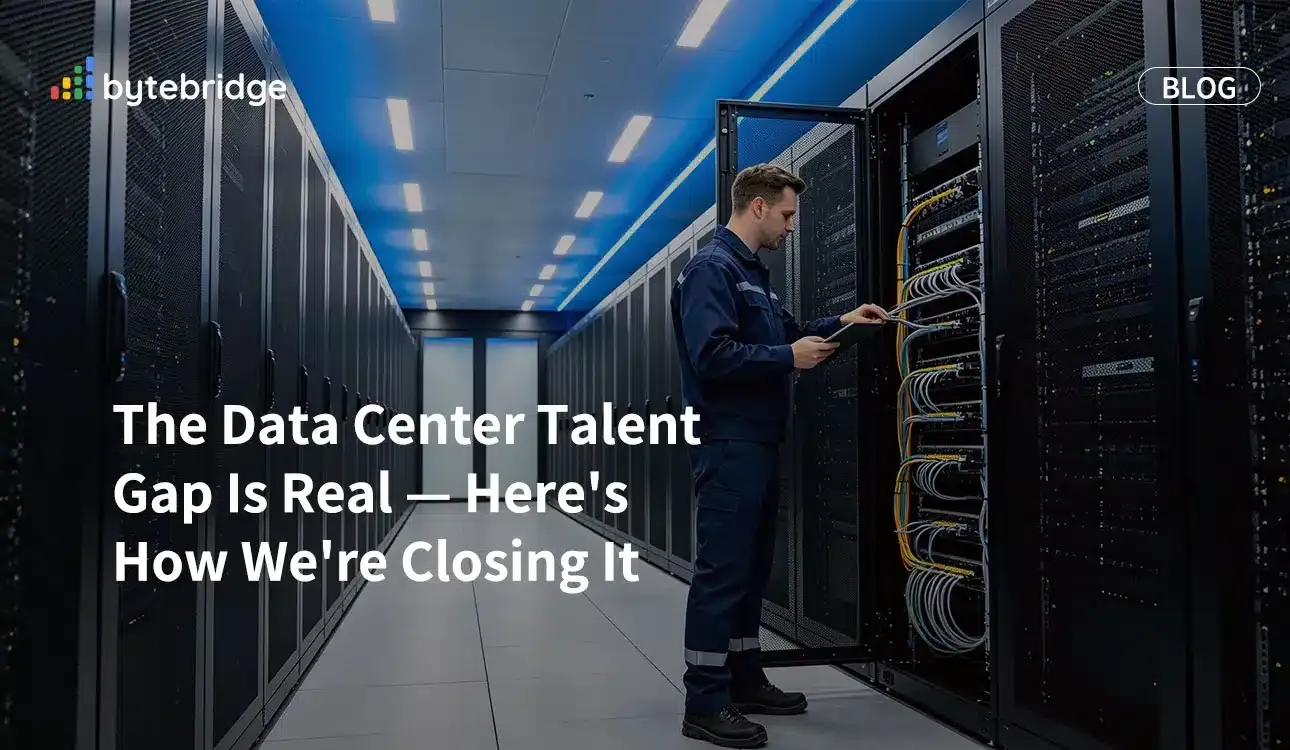
Every data center company is racing to build faster. Fewer are talking about who’s going to build it. There simply aren’t enough engineers and technicians trained in mechanical, electrical, cooling, and controls systems to keep up with current demand.
The problem is worse for newer systems. Liquid cooling, high-density power distribution, and AI-specific facility design are relatively new even for experienced data center engineers. Most training programs and university curricula haven’t caught up, which means the shortage isn’t just about headcount — it’s a shortage of people trained on the systems the industry actually needs now.
This isn’t a talking point. It’s a real constraint on how fast the industry can grow.
Big Tech is putting real money behind this too
Meta recently committed $115 million to its America’s Workforce Academy program to train workers — with no prior experience required — for skilled trades tied to AI data center construction — electricians, fiber technicians, welders, and more. When a hyperscaler invests at that scale, it confirms what we’re seeing on the ground: this is a structural problem the whole industry needs to solve, not just compete over the same shrinking talent pool.
Closing the gap ourselves: the FLCC program
Our answer is the Foundational Liquid Cooling Certification (FLCC) — the industry’s first vendor-neutral credential dedicated specifically to liquid cooling. The program covers direct-to-chip, immersion, and hybrid cooling architectures, rear-door heat exchangers, and system selection criteria: the exact knowledgebase an engineer needs to make sound decisions as rack densities climb past 1MW.
Participants complete a final assessment to earn the certification, so it’s a verified qualification rather than a seminar attendance record. Graduates leave with a physical certificate and a credential they can show employers, not just a line on a resume that says they showed up.
We built FLCC because we saw the same gap showing up across the industry: engineers with strong air-cooling backgrounds but no structured way to learn liquid cooling before it became mission-critical. Rather than wait for universities or trade programs to catch up, we built the training ourselves and took it directly to the engineers who need it. We see FLCC as our contribution to that same shift — purpose-built training for the specific technology reshaping the industry, rather than general funding aimed at traditional trades alone.
Why it matters
Customers increasingly ask about workforce depth when choosing a partner, because a facility is only as reliable as the team running it. A real, verifiable credential like FLCC isn’t just good training — it’s part of the reliability story we tell customers evaluating who should build and operate their infrastructure.
If you’re an engineer curious about liquid cooling, or a partner evaluating how we train our teams, we’d be glad to talk. [ Register for FLCC → ]
Have questions about whether it’s the right fit for your team? Reach out to us and we’ll walk you through it.

About The Author
Bill Evanger
Read more
- ByteBridge Launches Industry’s First Foundational Liquid Cooling Certification (FLCC) Program
- Liquid Cooling Training: Bridging the Knowledge Gap in AI Data Centers
- Direct-to-Chip Cooling Explained: The Future of Liquid Cooling in AI Data Centers
- Liquid Cooling System Architectures and Solutions for High-Density Data Centers