
The Next AI Infrastructure Challenge: Turning Power into Deployable Capacity

The global race to build AI infrastructure has entered a new phase.
For years, much of the conversation centered on access to advanced GPUs and the computing power needed to support increasingly demanding AI workloads. Today, a different constraint is becoming impossible to ignore: the availability of power and infrastructure to put that compute to work.
In late 2025, Microsoft CEO Satya Nadella acknowledged that the company had AI chips sitting in inventory because the necessary powered data center facilities were not ready to accommodate them. The challenge was no longer simply securing the hardware, but finding the power and infrastructure required to deploy it.
This reflects a broader shift across the industry. AI compute demand continues to accelerate, yet grid connection delays, limited available capacity, and lengthy development timelines are preventing infrastructure supply from keeping pace.
For hyperscalers and neocloud providers that have already committed significant capital to AI hardware, every delay in bringing compute online represents time when that investment cannot deliver its intended value.
The next challenge for the AI industry is not simply securing more power. It is turning available power into deployable, operational AI capacity.
The Scarcity of Deployable AI Capacity
Recent market data illustrates the scale of the challenge.
According to CBRE's H1 2026 North America Data Center Trends report, vacancy across eight primary North American markets fell to a record low of just 1.4%, despite total operating inventory growing to approximately 10.9 GW.
Even more telling, 80.4% of the 7.48 GW of capacity under construction was already preleased. Much of the infrastructure being developed has effectively been committed before it becomes operational.
The situation extends beyond North America.
JLL reported a 6.4% colocation vacancy rate across Europe's five major FLAP-D markets in Q2 2026, with Frankfurt falling to just 3.1%. Meanwhile, Cushman & Wakefield reported that Asia-Pacific data center vacancy declined to 10.3% in H1 2026, despite substantial additions to regional supply.
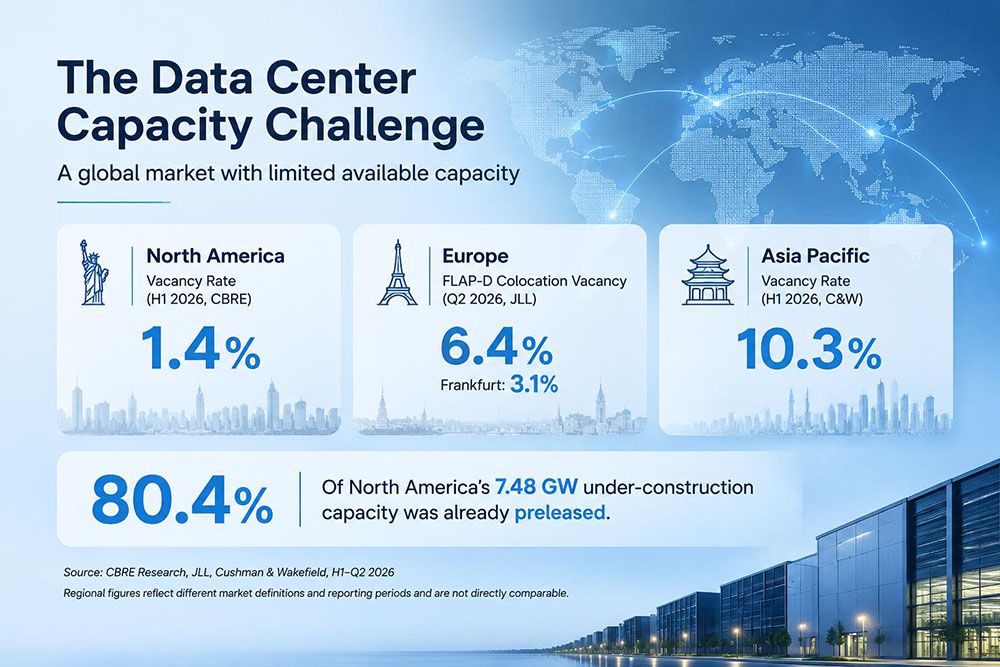
Although these figures reflect different geographic markets and methodologies, they point to a common reality: demand for data center capacity remains strong, and suitable infrastructure is increasingly difficult to secure.
For AI workloads, the challenge is even more complex. Available data center space does not necessarily mean available AI-ready capacity.
High-density GPU clusters require sufficient power, appropriate cooling systems, reliable connectivity, and infrastructure designed to support demanding operating conditions. Even where vacant space exists, it may not be suitable for the scale or density of deployment customers require.
Traditional data center development will remain essential. But with new capacity often requiring years of planning, construction, and grid connection, the industry needs to consider additional ways to bring AI infrastructure online sooner.
Unlocking the Potential of Existing Power and Infrastructure
One opportunity gaining attention is the potential to unlock what is often described as stranded power: existing electrical capacity that is available at a location but not being fully utilized.
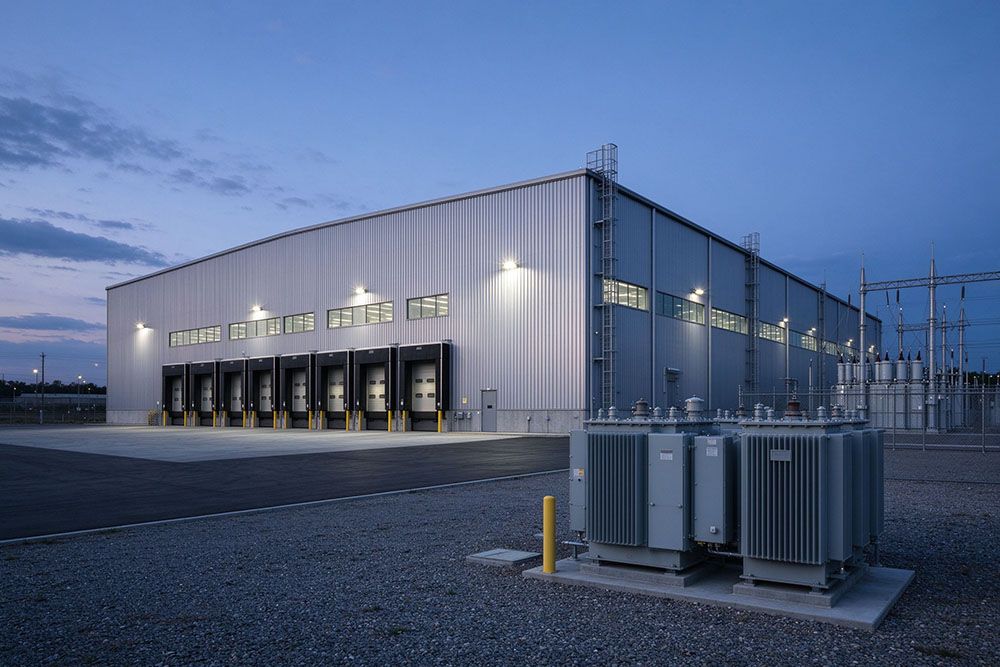
Across industrial and commercial real estate, certain facilities may have access to meaningful amounts of power without currently using their full allocation.
Cold storage facilities, warehouses, and other industrial properties are examples of sites that may warrant further evaluation.
For AI infrastructure developers and compute providers, these locations could offer an alternative to waiting for entirely new data center developments, particularly where smaller or modular deployments can meet immediate requirements.
Rather than starting every deployment with a new site and a new power connection, the opportunity is to identify locations where suitable power infrastructure already exists and assess whether it can be adapted for AI computing.
Modular data center infrastructure could play an important role in this approach, allowing computing environments to be designed and deployed around the characteristics of individual sites.
However, access to power alone does not guarantee deployment readiness. The real opportunity lies in determining which existing resources can be transformed into reliable AI infrastructure, and how quickly that transformation can be achieved.
From Available Power to Operational AI Capacity
Identifying a site with available power is one challenge. Turning that site into a reliable, operational AI computing environment is another.
A warehouse with 2 MW of available electrical capacity, for example, cannot automatically support 2 MW of IT load.
The actual deployable capacity depends on factors including electrical distribution, cooling requirements, facility efficiency, structural limitations, network connectivity, permitting, and operational resilience.
High-density AI workloads introduce additional complexity. Liquid cooling integration, mechanical and electrical engineering, equipment installation, testing, and commissioning must all work together to ensure the environment can operate safely and reliably.
For property owners and developers entering the AI infrastructure market, access to power or real estate does not necessarily translate into the technical capability to develop and operate a data center.
Successfully repurposing existing facilities requires a coordinated approach, from initial site feasibility and engineering design through implementation, commissioning, and ongoing operations.
At ByteBridge, we see an opportunity to apply our global engineering and delivery capabilities to help bridge this gap, supporting customers and partners as they evaluate alternative deployment models and bring AI infrastructure into operation.
The value lies not simply in identifying unused megawatts, but in the engineering and execution required to turn those megawatts into dependable, usable AI capacity.
A More Collaborative Approach to AI Infrastructure
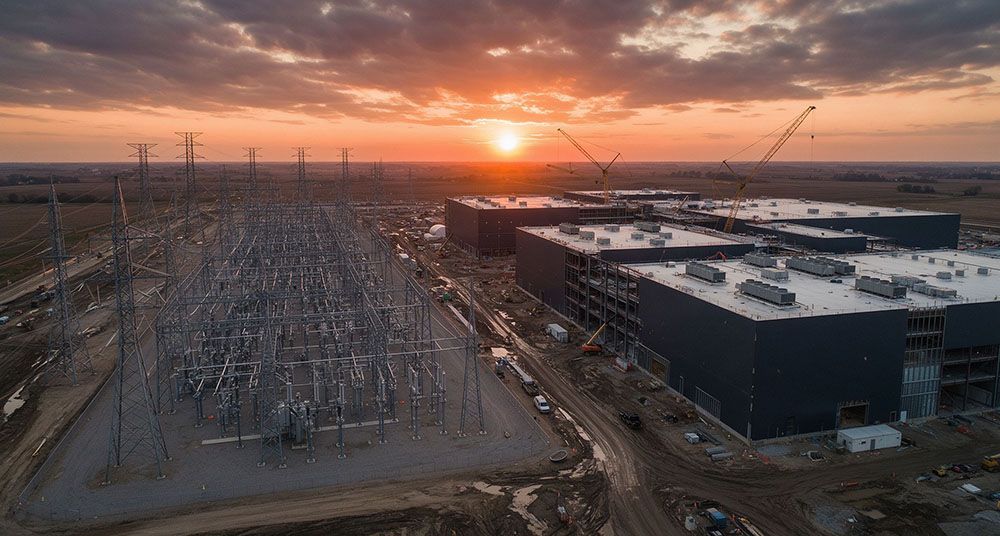
Addressing the capacity shortage will also require closer collaboration across industries that have traditionally operated independently.
Data center operators will continue to play a central role in meeting long-term demand. At the same time, real estate owners, industrial developers, energy companies, modular infrastructure providers, and technology integrators may have complementary capabilities that can help unlock additional capacity.
This shift is already reflected in broader market development trends.
JLL's 2026 EMEA Data Centre Report found that hyperscale campuses planned between 2026 and 2028 are located an average of 175 kilometers from major hub cities, compared with 46 kilometers for projects delivered between 2022 and 2025.
The change illustrates how access to power and land is influencing where the next generation of AI infrastructure will be built.
For infrastructure partners, this creates an opportunity to engage earlier in the development process, working alongside site and energy developers to evaluate locations, assess technical requirements, and coordinate delivery.
It also calls for a broader understanding of what AI infrastructure customers need.
For some, the priority will remain large-scale, purpose-built data center campuses. For others, particularly those seeking to activate pre-purchased compute within a shorter timeframe, smaller deployments, retrofits, or modular infrastructure may offer a viable alternative.
The industry will need both.
Turning Power into Deployable Capacity
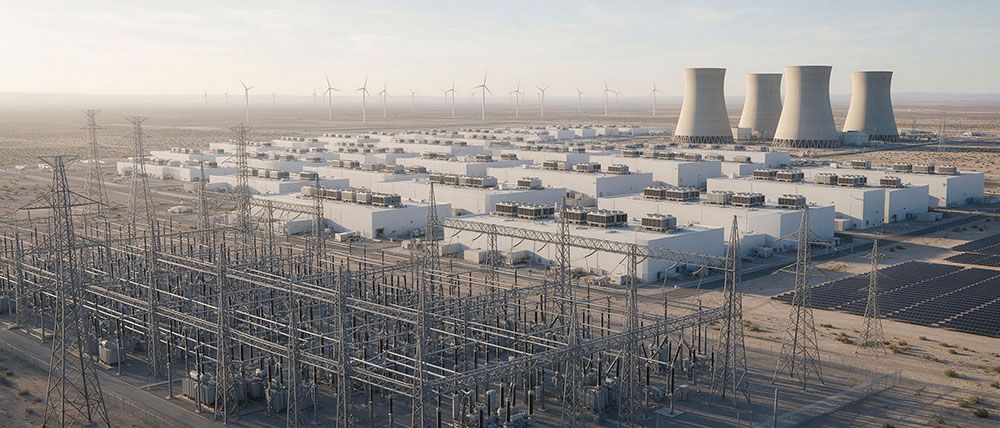
The rapid expansion of AI is creating significant pressure on the infrastructure required to support it. Yet that pressure is also encouraging the industry to rethink traditional development models.
The next wave of AI capacity will not necessarily come exclusively from new data center construction. Some opportunities may emerge from existing facilities, underutilized power resources, and partnerships that bring together expertise from energy, real estate, engineering, and technology.
None of these approaches eliminates the complexity of AI infrastructure deployment. Each requires careful evaluation, sound engineering, and reliable execution.
But as the gap between compute demand and deployable capacity continues to widen, the ability to identify and activate alternative infrastructure resources could become an increasingly important competitive advantage.
Ultimately, the next phase of AI infrastructure growth will be defined not only by access to power, but by the ability to turn that power into operational AI capacity, reliably, efficiently, and at scale.
References
- CBRE, North America Data Center Trends H1 2026.
- JLL, EMEA Data Centre Mid-Year 2026 Report.
- Cushman & Wakefield, APAC Data Centre Update H1 2026.
- Data Center Dynamics, Microsoft Has AI GPUs Sitting in Inventory Because It Lacks the Power Necessary to Install Them, November 3, 2025.

Marvin Cunanan brings over 10 years of experience in the IT and data center industry, with more than 6 years of supporting global enterprises as well as hyperscale clients. His core competencies include delivering services and solutions across various IT disciplines.