AI Is Reshaping Infrastructure Requirements
The exponential growth of artificial intelligence is fundamentally transforming the digital landscape. Organizations are rapidly constructing large-scale AI compute environments tailored for continuous model training and inference. This shift has given rise to “AI factories,” expanding infrastructure demand far beyond traditional centralized training environments. Consequently, data center infrastructure must evolve to support unprecedented GPU density and skyrocketing rack capacities, driving a critical need for advanced cooling architectures and scalable power distribution.
Why Traditional Deployment Models Are Struggling
Traditional data center deployment models are ill-equipped to handle the unique pressures of the AI era. Legacy facilities rely on static infrastructure and fixed capacity planning, which clash with unpredictable AI growth and rapid scaling demands. Furthermore, traditional air cooling solutions hit a hard physical limit when faced with the high-density thermal loads generated by modern accelerators. These factors, combined with painfully long deployment timelines, create a severe mismatch with today’s urgent demand for immediate compute capacity.
AI Is Driving the Shift Toward Modular
To overcome these bottlenecks, the industry is embracing modular data center infrastructure. By assembling and integrating infrastructure systems off-site before deployment, companies can significantly reduce on-site construction complexity. Prefabrication allows site preparation and equipment manufacturing to occur concurrently, dramatically accelerating deployment timelines. This repeatable architecture leverages standardized designs to improve consistency, ensure rigorous quality control, and enable smooth global scalability through pre-engineered, scalable blocks.
Traditional vs Modular Architecture
The contrast between traditional and modular paradigms highlights why the industry is shifting toward the latter. Traditional architecture relies on sequential construction, on-site integration, and lengthy commissioning processes, resulting in difficult scalability and a constant need for expensive retrofitting. In contrast, modular architecture is AI-ready by design. It utilizes parallel deployment, factory integration, and pre-tested systems. This approach eliminates on-site guesswork, replaces complex field engineering with simple modular expansion, and provides a highly predictable, repeatable layout.
The Building Blocks of Modular AI Infrastructure
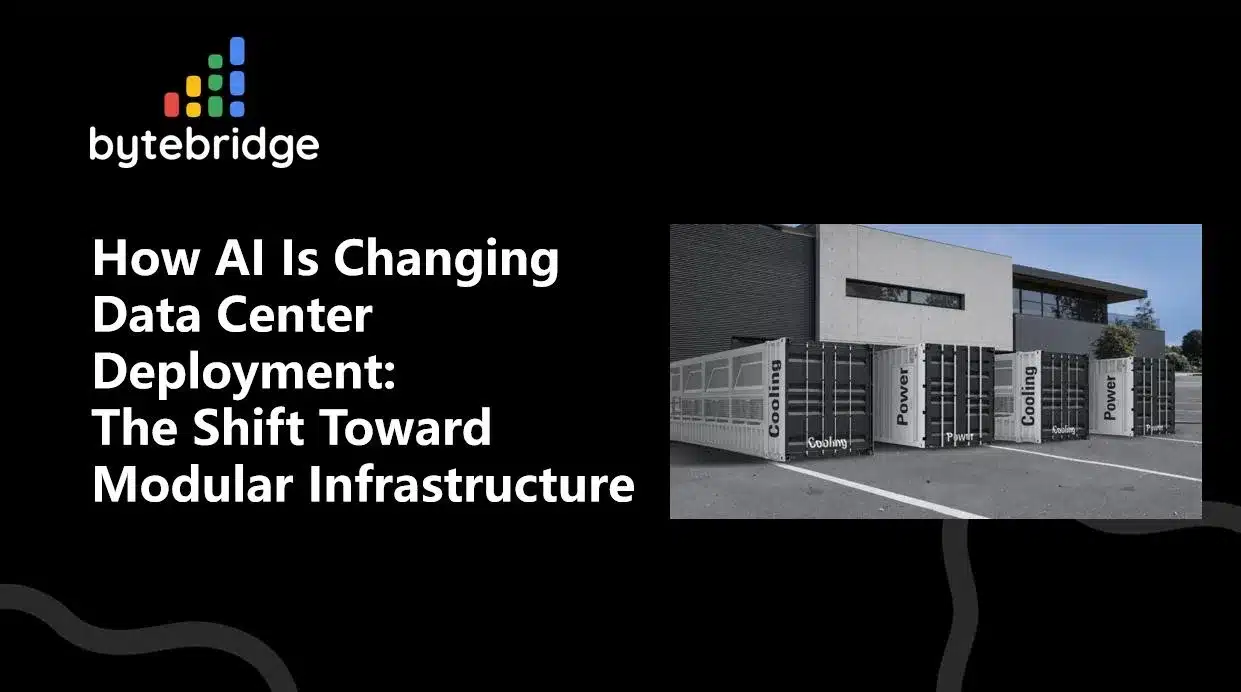
A robust modular AI infrastructure is built upon three core components. First, the IT Module encompasses specialized AI compute modules, heavy-duty GPU clusters, and modular data halls designed specifically for high-performance workloads. Second, the Power Module consists of containerized or skid-mounted modules that deliver highly scalable electrical distribution. Finally, the Cooling Module integrates advanced thermal management systems, including liquid cooling units, coolant distribution units (CDUs), chillers, and free cooling systems.
High-Density AI Is Reshaping Cooling Architecture
The primary driver behind this architectural shift is the dramatic rise in rack density. Traditional enterprise environments typically operate at a modest 5 to 10 kW per rack, while hyperscale facilities generally handle 15 to 30 kW. However, modern AI GPU clusters demand an astonishing 50 to 100+ kW per rack. Managing these massive thermal loads requires a complete overhaul of traditional cooling, forcing operators to replace conventional air systems with direct-to-chip or immersion liquid cooling solutions.
Factory Integration & Prefabrication
Maximizing the efficiency of modular architecture requires seamless factory integration and prefabrication. During the initial design and engineering phases, engineers utilize Building Information Modeling (BIM) and strict design coordination to finalize a standardized architecture. Every component is assembled, wired, and tested in a controlled factory environment, minimizing defects and ensuring that the final product arrives on-site ready for immediate interconnection.
Scaling AI Infrastructure Globally Is Operationally Complex
Expanding AI infrastructure on a global scale introduces severe operational hurdles. Organizations must deal with regional compliance, varying local standards, and highly fragmented supply chain coordination. Furthermore, the global shortage of specialized field talent complicates on-site assembly and commissioning. As deployments span multiple geographies, achieving execution consistency becomes a paramount challenge that traditional construction methods simply cannot solve.
Successful AI Deployment Requires More Than Hardware
Building an effective AI engine requires a holistic approach that extends far beyond purchasing high-end chips. A successful deployment demands the harmonious integration of multiple foundational elements: robust power delivery, advanced cooling, ultra-low-latency networking, rapid deployment methodologies, and expert system integration. Overcoming global operational complexities requires unified global coordination to ensure all components work together seamlessly.
How ByteBridge Supports Your AI Infra Deployment
ByteBridge provides the end-to-end expertise required to navigate this new era of infrastructure design. We specialize in comprehensive modular infrastructure deployment and seamless liquid cooling integration to support high-density workloads. From white space management and structured cabling to global project execution, ByteBridge ensures consistency and speed across all international deployments. For more details on optimizing your AI data center strategy, please feel free to contact us.